Northern lights in Utah tonight
The aurora reaches Utah at about Kp 7.2 in the far north of the state and Kp 7.4 at its southern edge. SWPC's highest forecast Kp over the next three days is 2, in the 03-06 UTC block on Mon, Sep 21. Not tonight. The forecast Kp of 2 is well below what it takes for the aurora to reach this far south.
From NOAA’s Space Weather Prediction Center, read Sep 20, 18:08 UTC.
The oval right now
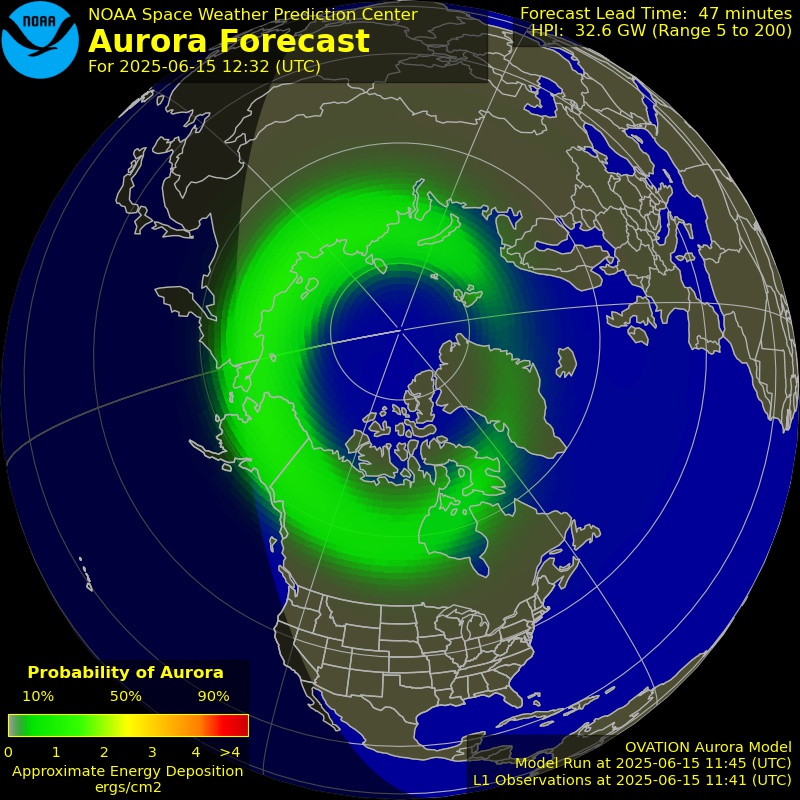
NOAA’s OVATION model: the chance of aurora overhead 30 to 90 minutes from now, valid Sep 20, 19:10 UTC. Green is a low chance, red a high one.
Rain and snow mean cloud, and cloud is the last thing between a forecast aurora and the sky you are standing under. Each town page carries that town’s own sky cover forecast for the dark hours.
Open the live map with the aurora forecast
Aurora forecast from NOAA’s Space Weather Prediction Center. Original at SWPC
Tonight at Garden City
The most poleward town in Utah with a page, and the first place in the state an aurora reaches. Cloud cover is on each town’s own page.
No tonight
Not tonight. The forecast Kp of 2 is well below what it takes for the aurora to reach this far south.
- The aurora reaches this place at about Kp 7.2, which is 49 degrees geomagnetic latitude on NOAA's storm scales.
- SWPC forecasts a highest Kp of 2 (2.00) during tonight's dark hours: quiet.
- The moon is waxing gibbous, 71% lit, and up for part of the dark hours.
Towns best placed in Utah
The 24 most poleward of the 48 towns in Utah with a page. Each page gives tonight’s chance there, the darkness, the moon and that town’s own cloud forecast.
- Garden CityRich County · population 580 · 48.8° geomagneticKp 7.2
- LewistonCache County · population 1,768 · 48.8° geomagneticKp 7.2
- RichmondCache County · population 2,580 · 48.7° geomagneticKp 7.3
- TrentonCache County · population 507 · 48.7° geomagneticKp 7.3
- ClarkstonCache County · population 694 · 48.7° geomagneticKp 7.3
- AmalgaCache County · population 514 · 48.7° geomagneticKp 7.3
- NewtonCache County · population 782 · 48.7° geomagneticKp 7.3
- SmithfieldCache County · population 10,782 · 48.7° geomagneticKp 7.3
- Hyde ParkCache County · population 4,375 · 48.6° geomagneticKp 7.3
- BensonCache County · population 1,485 · 48.6° geomagneticKp 7.3
- North LoganCache County · population 10,181 · 48.6° geomagneticKp 7.3
- RiversideBox Elder County · population 760 · 48.6° geomagneticKp 7.3
- RandolphRich County · population 462 · 48.6° geomagneticKp 7.3
- LoganCache County · population 50,371 · 48.6° geomagneticKp 7.3
- River HeightsCache County · population 1,941 · 48.6° geomagneticKp 7.3
- ProvidenceCache County · population 7,124 · 48.5° geomagneticKp 7.3
- GarlandBox Elder County · population 2,448 · 48.5° geomagneticKp 7.3
- MendonCache County · population 1,348 · 48.5° geomagneticKp 7.3
- MillvilleCache County · population 1,970 · 48.5° geomagneticKp 7.3
- NibleyCache County · population 6,451 · 48.5° geomagneticKp 7.3
- TremontonBox Elder County · population 8,227 · 48.5° geomagneticKp 7.3
- ElwoodBox Elder County · population 1,070 · 48.5° geomagneticKp 7.3
- ThatcherBox Elder County · population 789 · 48.5° geomagneticKp 7.3
- HyrumCache County · population 7,962 · 48.5° geomagneticKp 7.3
Every town in Utah with a page
48 towns at 48 degrees geomagnetic latitude or higher, which a strong storm reaches. The figure after each is the Kp it takes there.
A
- Amalga Kp 7.3
B
- Bear River City Kp 7.3
- Benson Kp 7.3
- Brigham City Kp 7.3
C
E
F
- Farr West Kp 7.4
G
- Garden City Kp 7.2
- Garland Kp 7.3
H
- Harrisville Kp 7.4
- Honeyville Kp 7.3
- Huntsville Kp 7.4
- Hyde Park Kp 7.3
- Hyrum Kp 7.3
L
M
- Manila Kp 7.4
- Mantua Kp 7.3
- Marriott-Slaterville Kp 7.4
- Mendon Kp 7.3
- Millville Kp 7.3
N
- Newton Kp 7.3
- Nibley Kp 7.3
- North Logan Kp 7.3
- North Ogden Kp 7.4
O
- Ogden Kp 7.4
P
- Paradise Kp 7.3
- Perry Kp 7.3
- Plain City Kp 7.4
- Pleasant View Kp 7.4
- Providence Kp 7.3
R
- Randolph Kp 7.3
- Richmond Kp 7.3
- River Heights Kp 7.3
- Riverside Kp 7.3
S
- Smithfield Kp 7.3
- South Ogden Kp 7.4
- South Willard Kp 7.4
T
W
- Wellsville Kp 7.3
- West Haven Kp 7.4
- Willard Kp 7.4
- Wolf Creek Kp 7.4
How far south each storm level reaches
NOAA’s space weather scales state the geomagnetic latitude each level of geomagnetic storm reaches, and the places its aurora has been seen from. The geographic latitudes are those lines converted with the geomagnetic dipole; the aurora sits low on the northern horizon there, and overhead far poleward of it.
| Storm | Geomagnetic | Central US | Eastern US | Northern Europe | NOAA says the aurora |
|---|---|---|---|---|---|
| G1 MinorKp 5 | 60° | 52°N | 51°N | 61°N | commonly visible at high latitudes: northern Michigan and Maine |
| G2 ModerateKp 6 | 55° | 47°N | 46°N | 56°N | has been seen as low as New York and Idaho |
| G3 StrongKp 7 | 50° | 42°N | 41°N | 51°N | has been seen as low as Illinois and Oregon |
| G4 SevereKp 8 | 45° | 37°N | 36°N | 45°N | has been seen as low as Alabama and northern California |
| G5 ExtremeKp 9 | 40° | 32°N | 31°N | 40°N | has been seen as low as Florida and southern Texas |
Source: NOAA space weather scales, swpc.noaa.gov/noaa-scales-explanation. Below Kp 5 the oval contracts more slowly; this section runs the line from 66 degrees geomagnetic at Kp 0 to the scale’s 60 degrees at Kp 5.
Kp by 3-hour block
SWPC’s planetary K index forecast, three days ahead. Kp is a single number for the whole planet, from magnetometers around the world, on a scale of 0 to 9 in thirds.
| Block (UTC) | Kp | Level | Seen from | Central US |
|---|---|---|---|---|
| 1.33 | Quiet | 64° geomag. | 56°N | |
| 1.33 | Quiet | 64° geomag. | 56°N | |
| 1.67 | Quiet | 64° geomag. | 56°N | |
| 2.00 | Quiet | 64° geomag. | 55°N | |
| 1.67 | Quiet | 64° geomag. | 56°N | |
| 1.33 | Quiet | 64° geomag. | 56°N | |
| 0.67 | Quiet | 65° geomag. | 57°N | |
| 1.33 | Quiet | 64° geomag. | 56°N | |
| 1.33 | Quiet | 64° geomag. | 56°N | |
| 1.67 | Quiet | 64° geomag. | 56°N | |
| 1.67 | Quiet | 64° geomag. | 56°N | |
| 1.33 | Quiet | 64° geomag. | 56°N | |
| 1.33 | Quiet | 64° geomag. | 56°N | |
| 1.33 | Quiet | 64° geomag. | 56°N | |
| 1.33 | Quiet | 64° geomag. | 56°N | |
| 1.33 | Quiet | 64° geomag. | 56°N | |
| 1.67 | Quiet | 64° geomag. | 56°N | |
| 1.67 | Quiet | 64° geomag. | 56°N | |
| 1.67 | Quiet | 64° geomag. | 56°N |
The forecast is for the planet, not for your sky. A block at Kp 5 means the field is disturbed enough for the aurora to reach 60 degrees geomagnetic somewhere along the night side; whether you see it depends on being on the night side, on darkness, and on the clouds.
Other states with aurora pages
- Alaska
- Colorado
- Connecticut
- Delaware
- District of Columbia
- Idaho
- Illinois
- Indiana
- Iowa
- Kansas
- Kentucky
- Maine
- Maryland
- Massachusetts
- Michigan
- Minnesota
- Missouri
- Montana
- Nebraska
- Nevada
- New Hampshire
- New Jersey
- New York
- North Dakota
- Ohio
- Oregon
- Pennsylvania
- Rhode Island
- South Dakota
- Vermont
- Virginia
- Washington
- West Virginia
- Wisconsin
- Wyoming
What this means
Each place is placed by its geomagnetic latitude, measured from the geomagnetic dipole pole, and compared with the reach NOAA states for each storm level on its space weather scales: G1 (Kp 5) about 60 degrees geomagnetic, G2 55, G3 50, G4 45, G5 (Kp 9) 40. Reading that backwards gives the Kp a place needs. Below Kp 5 the oval contracts more slowly and the line runs from 66 degrees at Kp 0 to 60 at Kp 5.
The forecasts have different horizons and the pages keep them apart: OVATION is the only thing that knows whether an aurora is out now, and it reaches 30 to 90 minutes ahead; the planetary Kp forecast runs three days; the 27-day outlook names likely active days and is not a forecast of any one night. None of them knows the clouds, which is why a town page reads its own forecast for those.
Sources
From NOAA’s Space Weather Prediction Center: the OVATION aurora forecast, the planetary K index forecast, the 3-day forecast, the 27-day outlook, its watches, warnings and alerts, and the real-time solar wind. Read Sep 20, 18:08 UTC.