Northern lights in Colorado tonight
The aurora reaches Colorado at about Kp 7.2 in the far north of the state and Kp 7.4 at its southern edge. SWPC's highest forecast Kp over the next three days is 2, in the 03-06 UTC block on Mon, Sep 21. Not tonight. The forecast Kp of 2 is well below what it takes for the aurora to reach this far south.
From NOAA’s Space Weather Prediction Center, read Sep 20, 23:19 UTC.
The oval right now
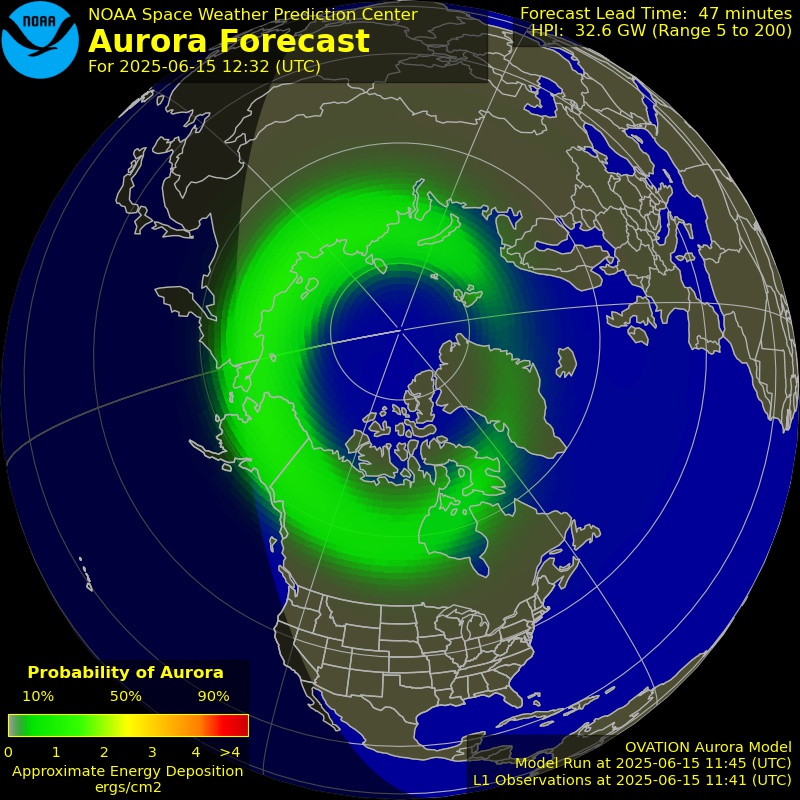
NOAA’s OVATION model: the chance of aurora overhead 30 to 90 minutes from now, valid Sep 21, 00:24 UTC. Green is a low chance, red a high one.
Rain and snow mean cloud, and cloud is the last thing between a forecast aurora and the sky you are standing under. Each town page carries that town’s own sky cover forecast for the dark hours.
Open the live map with the aurora forecast
Aurora forecast from NOAA’s Space Weather Prediction Center. Original at SWPC
Tonight at Julesburg
The most poleward town in Colorado with a page, and the first place in the state an aurora reaches. Cloud cover is on each town’s own page.
No tonight
Not tonight. The forecast Kp of 2 is well below what it takes for the aurora to reach this far south.
- The aurora reaches this place at about Kp 7.2, which is 49 degrees geomagnetic latitude on NOAA's storm scales.
- SWPC forecasts a highest Kp of 2 (2.00) during tonight's dark hours: quiet.
- The moon is waxing gibbous, 71% lit, and up for part of the dark hours.
Towns best placed in Colorado
The 15 most poleward of the 15 towns in Colorado with a page. Each page gives tonight’s chance there, the darkness, the moon and that town’s own cloud forecast.
- JulesburgSedgwick County · population 1,237 · 48.8° geomagneticKp 7.2
- HaxtunPhillips County · population 930 · 48.4° geomagneticKp 7.3
- HolyokePhillips County · population 2,251 · 48.4° geomagneticKp 7.3
- SterlingLogan County · population 14,104 · 48.4° geomagneticKp 7.3
- WellingtonLarimer County · population 7,807 · 48.3° geomagneticKp 7.3
- PierceWeld County · population 873 · 48.2° geomagneticKp 7.4
- LaporteLarimer County · population 2,450 · 48.2° geomagneticKp 7.4
- AultWeld County · population 1,622 · 48.2° geomagneticKp 7.4
- WaldenJackson County · population 584 · 48.2° geomagneticKp 7.4
- Fort CollinsLarimer County · population 170,924 · 48.1° geomagneticKp 7.4
- EatonWeld County · population 4,928 · 48.1° geomagneticKp 7.4
- SeveranceWeld County · population 3,697 · 48.1° geomagneticKp 7.4
- TimnathLarimer County · population 625 · 48.1° geomagneticKp 7.4
- WindsorWeld County · population 32,716 · 48.0° geomagneticKp 7.4
- GreeleyWeld County · population 108,795 · 48.0° geomagneticKp 7.4
Every town in Colorado with a page
15 towns at 48 degrees geomagnetic latitude or higher, which a strong storm reaches. The figure after each is the Kp it takes there.
A
- Ault Kp 7.4
E
- Eaton Kp 7.4
F
- Fort Collins Kp 7.4
G
- Greeley Kp 7.4
H
J
- Julesburg Kp 7.2
L
- Laporte Kp 7.4
P
- Pierce Kp 7.4
S
T
- Timnath Kp 7.4
W
- Walden Kp 7.4
- Wellington Kp 7.3
- Windsor Kp 7.4
How far south each storm level reaches
NOAA’s space weather scales state the geomagnetic latitude each level of geomagnetic storm reaches, and the places its aurora has been seen from. The geographic latitudes are those lines converted with the geomagnetic dipole; the aurora sits low on the northern horizon there, and overhead far poleward of it.
| Storm | Geomagnetic | Central US | Eastern US | Northern Europe | NOAA says the aurora |
|---|---|---|---|---|---|
| G1 MinorKp 5 | 60° | 52°N | 51°N | 61°N | commonly visible at high latitudes: northern Michigan and Maine |
| G2 ModerateKp 6 | 55° | 47°N | 46°N | 56°N | has been seen as low as New York and Idaho |
| G3 StrongKp 7 | 50° | 42°N | 41°N | 51°N | has been seen as low as Illinois and Oregon |
| G4 SevereKp 8 | 45° | 37°N | 36°N | 45°N | has been seen as low as Alabama and northern California |
| G5 ExtremeKp 9 | 40° | 32°N | 31°N | 40°N | has been seen as low as Florida and southern Texas |
Source: NOAA space weather scales, swpc.noaa.gov/noaa-scales-explanation. Below Kp 5 the oval contracts more slowly; this section runs the line from 66 degrees geomagnetic at Kp 0 to the scale’s 60 degrees at Kp 5.
Kp by 3-hour block
SWPC’s planetary K index forecast, three days ahead. Kp is a single number for the whole planet, from magnetometers around the world, on a scale of 0 to 9 in thirds.
| Block (UTC) | Kp | Level | Seen from | Central US |
|---|---|---|---|---|
| 0.67 | Quiet | 65° geomag. | 57°N | |
| 1.67 | Quiet | 64° geomag. | 56°N | |
| 2.00 | Quiet | 64° geomag. | 55°N | |
| 1.67 | Quiet | 64° geomag. | 56°N | |
| 1.33 | Quiet | 64° geomag. | 56°N | |
| 0.67 | Quiet | 65° geomag. | 57°N | |
| 1.33 | Quiet | 64° geomag. | 56°N | |
| 1.33 | Quiet | 64° geomag. | 56°N | |
| 1.67 | Quiet | 64° geomag. | 56°N | |
| 1.67 | Quiet | 64° geomag. | 56°N | |
| 2.00 | Quiet | 64° geomag. | 55°N | |
| 1.67 | Quiet | 64° geomag. | 56°N | |
| 1.33 | Quiet | 64° geomag. | 56°N | |
| 0.67 | Quiet | 65° geomag. | 57°N | |
| 0.67 | Quiet | 65° geomag. | 57°N | |
| 1.67 | Quiet | 64° geomag. | 56°N | |
| 1.67 | Quiet | 64° geomag. | 56°N | |
| 1.67 | Quiet | 64° geomag. | 56°N |
The forecast is for the planet, not for your sky. A block at Kp 5 means the field is disturbed enough for the aurora to reach 60 degrees geomagnetic somewhere along the night side; whether you see it depends on being on the night side, on darkness, and on the clouds.
Other states with aurora pages
- Alaska
- Connecticut
- Delaware
- District of Columbia
- Idaho
- Illinois
- Indiana
- Iowa
- Kansas
- Kentucky
- Maine
- Maryland
- Massachusetts
- Michigan
- Minnesota
- Missouri
- Montana
- Nebraska
- Nevada
- New Hampshire
- New Jersey
- New York
- North Dakota
- Ohio
- Oregon
- Pennsylvania
- Rhode Island
- South Dakota
- Utah
- Vermont
- Virginia
- Washington
- West Virginia
- Wisconsin
- Wyoming
What this means
Each place is placed by its geomagnetic latitude, measured from the geomagnetic dipole pole, and compared with the reach NOAA states for each storm level on its space weather scales: G1 (Kp 5) about 60 degrees geomagnetic, G2 55, G3 50, G4 45, G5 (Kp 9) 40. Reading that backwards gives the Kp a place needs. Below Kp 5 the oval contracts more slowly and the line runs from 66 degrees at Kp 0 to 60 at Kp 5.
The forecasts have different horizons and the pages keep them apart: OVATION is the only thing that knows whether an aurora is out now, and it reaches 30 to 90 minutes ahead; the planetary Kp forecast runs three days; the 27-day outlook names likely active days and is not a forecast of any one night. None of them knows the clouds, which is why a town page reads its own forecast for those.
Sources
From NOAA’s Space Weather Prediction Center: the OVATION aurora forecast, the planetary K index forecast, the 3-day forecast, the 27-day outlook, its watches, warnings and alerts, and the real-time solar wind. Read Sep 20, 23:19 UTC.