Northern lights in Warren tonight
No tonight
Not tonight. The forecast Kp of 3 is well below what it takes for the aurora to reach this far south. The sky is forecast overcast.
- The aurora reaches this place at about Kp 6.4, which is 53 degrees geomagnetic latitude on NOAA's storm scales.
- SWPC forecasts a highest Kp of 3 (3.00) during tonight's dark hours: unsettled.
- The forecast for the dark hours is overcast, 93% sky cover on average.
- The moon is full moon, 100% lit, and up for most of the dark hours; it will wash out a faint arc, though a bright display shows through.
Warren forecastLive radar hereKp forecast
From NOAA’s Space Weather Prediction Center and the National Weather Service forecast for this grid cell, read Sep 26, 12:34 UTC. Times are Eastern Daylight Time.
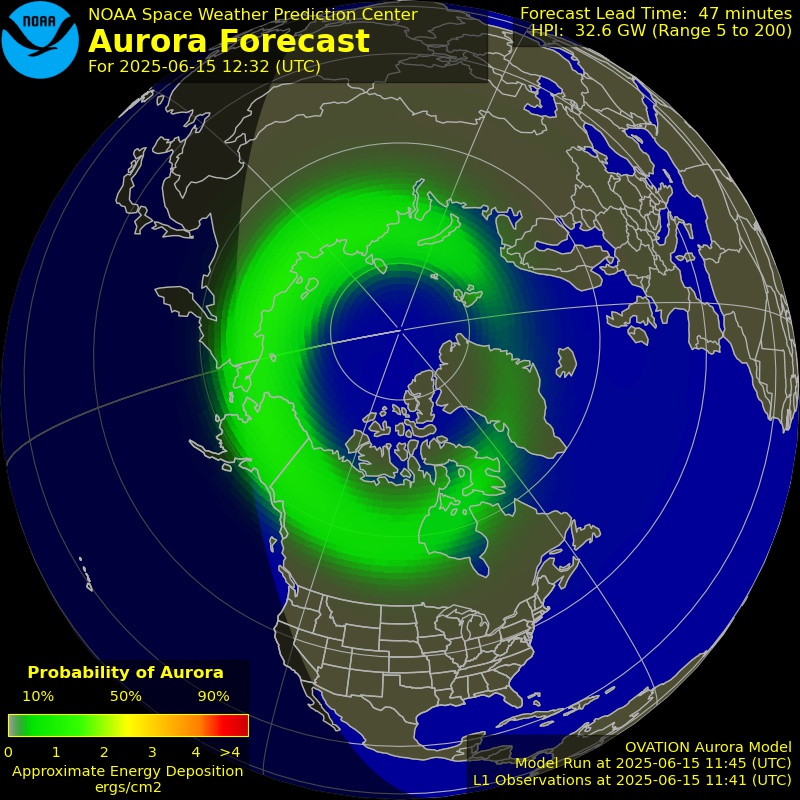
The oval right now
NOAA’s OVATION model: the chance of aurora overhead 30 to 90 minutes from now, valid Sep 26, 13:22 UTC. Green is a low chance, red a high one.
Rain and snow mean cloud, and cloud is the last thing between a forecast aurora and the sky you are standing under. Each town page carries that town’s own sky cover forecast for the dark hours.
Open the live map with the aurora forecast
Aurora forecast from NOAA’s Space Weather Prediction Center. Original at SWPC
Tonight at Warren
- Geomagnetic latitude
- 53.1° (43.92°N, 71.89°W)
- The aurora reaches here at
- Kp 6.4
- Highest Kp forecast tonight
- 3 (3.00), unsettled
- Cloud cover in the dark hours
- 93% on average, overcast
- Moon
- 100% lit, strong interference
| Hour | Kp | Sky cover | Sky | Aurora |
|---|---|---|---|---|
| 3- | 90% | overcast | Below the line | |
| 3- | 93% | overcast | Below the line | |
| 3- | 92% | overcast | Below the line | |
| 3 | 91% | overcast | Below the line | |
| 3 | 90% | overcast | Below the line | |
| 3 | 90% | overcast | Below the line | |
| 3- | 96% | overcast | Below the line | |
| 3- | 96% | overcast | Below the line | |
| 3- | 97% | overcast | Below the line | |
| 3- | 97% | overcast | Below the line |
Darkness and the moon
8.8 hours of full darkness tonight. The moon is full moon, 100% lit, and up for most of the dark hours; it will wash out a faint arc, though a bright display shows through.
- Sunset
- Sat 6:37 PM
- Civil twilight ends
- Sat 7:06 PM
- Nautical twilight ends
- Sat 7:40 PM
- Full darkness begins
- Sat 8:14 PM
- Full darkness ends
- Sun 5:04 AM
- Sunrise
- Sun 6:41 AM
- Moonrise
- Sat 6:24 PM
- Moonset
- Sun 7:44 AM
Full darkness is astronomical twilight’s end, the sun 18 degrees below the horizon. Town lights matter as much as the moon: a few minutes’ drive away from them is usually the difference between seeing an arc and not.
The best hours tonight
Sat 10:44 PM to Sun 1:44 AM. Chosen for the darkest, clearest stretch nearest local midnight, which is when the auroral oval swings furthest toward the equator over any one place. Face north, away from town lights, and give your eyes twenty minutes.
Photographing the aurora from Warren
Face 360° (N), toward the geomagnetic pole. At tonight’s highest forecast, Kp 3, the oval stays below the horizon here; at Kp 6+ it would reach it.
- Face
- 360° (N), toward the geomagnetic pole
- Moon
- 100% lit and up for much of the night: settings a stop lower, and it lights the foreground
| Kp | Height above the horizon | Camera |
|---|---|---|
| 6+ | lower edge about 0°, tall rays to about 7° | ISO 800 to 1600, widest the lens has, f/2.8 or wider, 15 to 25 seconds |
| 7 | lower edge about 4°, tall rays to about 14° | ISO 800 to 1600, widest the lens has, f/2.8 or wider, 15 to 25 seconds |
| 8 | lower edge about 23°, tall rays to about 47° | ISO 400 to 400, f/2.8 to f/4, 2 to 8 seconds |
| 9 | overhead or toward the equator of you: look up and all around | ISO 400 to 400, f/2.8 to f/4, 2 to 8 seconds |
Focus manually on a bright star or a distant light at infinity, then check a test frame zoomed in. Shoot raw if the camera can. To keep stars as points, stay under about 500 divided by the lens’s full-frame focal length in seconds: 36 s at 14 mm, 21 s at 24 mm. Fast-moving curtains blur in long exposures; shorten the shutter and raise the ISO when the display is active.
On a phone: iPhone Night mode and Pixel Night Sight lengthen the exposure when the phone is held still, so set it on something solid or a small tripod and use the timer; turn the flash off. Google’s Night Sight astrophotography mode takes up to 4 minutes on a tripod, split into frames of 16 seconds or less so stars do not trail. A glow that looks gray to the eye often comes out green: cameras see color at light levels the eye cannot.
Heights are for the arc’s lower edge, about 100 km up, and the top of tall rays, about 250 km, over the oval’s edge placed where this section’s viewline puts it for each Kp; the real oval moves minute to minute. Settings start from the Canadian Space Agency’s guide (10 to 25 seconds, the widest aperture, ISO 400 or 800, focus on the stars) and are scaled here for brightness and the moon. Aurora heights from the University of Alaska Fairbanks Geophysical Institute; viewing distance from SWPC’s viewing tips; phone exposures from Google Research.
The next three days
The highest Kp forecast each UTC day, against the Kp 6.4 this town needs. A UTC day runs from early evening to early evening in North America, so the night of the 26th sits in two of these rows.
| Day (UTC) | Highest Kp | Level | Here |
|---|---|---|---|
| Sat, Sep 26 | 2+ | Quiet | Below the line |
| Sun, Sep 27 | 3 | Unsettled | Below the line |
| Mon, Sep 28 | 2 | Quiet | Below the line |
| Tue, Sep 29 | 2- | Quiet | Below the line |
What this means
This town is at 53.1 degrees geomagnetic latitude, measured from the geomagnetic dipole pole. NOAA’s space weather scales state where a storm of each level is seen: a G1 (Kp 5) at about 60 degrees geomagnetic, a G2 at 55, a G3 at 50, a G4 at 45 and a G5 (Kp 9) at 40, five degrees a step. Reading that backwards gives the Kp 6.4 this town needs. Below Kp 5 the line runs from 66 degrees geomagnetic at Kp 0 to the scale’s 60 at Kp 5.
Against that go three things the sky does: how dark it gets, from the sun’s altitude here; the moon, from its phase and whether it is above the horizon in those hours; and the cloud cover in this town’s own National Weather Service forecast. The Kp forecast runs three days and is a forecast of the planet’s magnetic field, not of one sky. Only OVATION knows whether an aurora is out right now, and it sees 30 to 90 minutes ahead, because that is how long the solar wind takes to arrive from the spacecraft that measures it.
At the viewing line the aurora is low on the northern horizon, not overhead, and often only a camera sees color in it. Sources: SWPC 3-day forecast, NOAA space weather scales.
Sources
From NOAA’s Space Weather Prediction Center: the OVATION aurora forecast, the planetary K index forecast, the 3-day forecast, the 27-day outlook, its watches, warnings and alerts, and the real-time solar wind. Read Sep 26, 12:34 UTC.