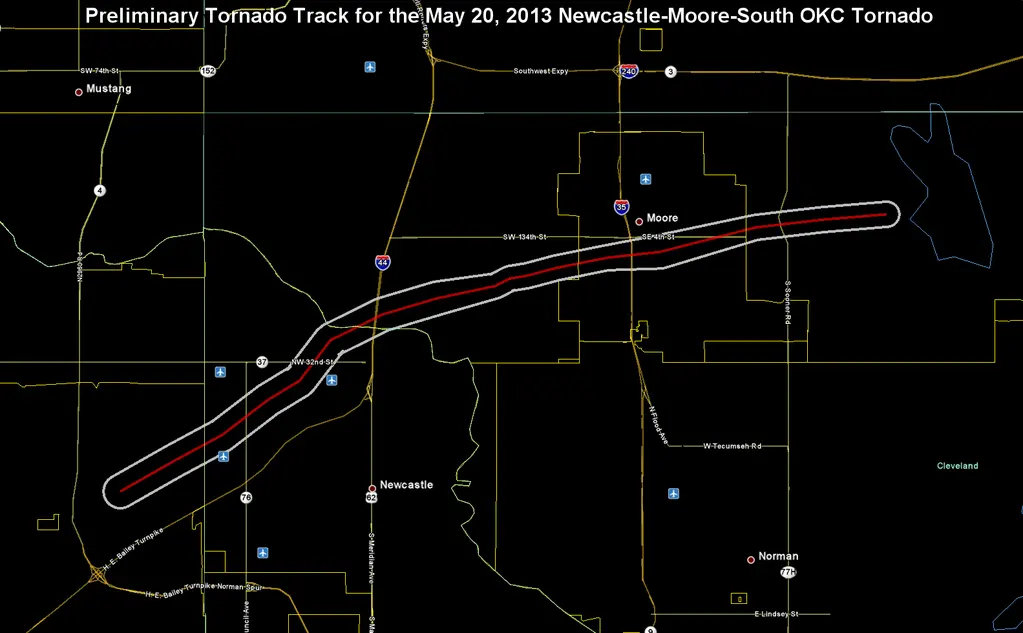
The Moore, Oklahoma tornado of May 20, 2013
EF5 McClain and Cleveland counties, Oklahoma · surveyed by NWS Norman
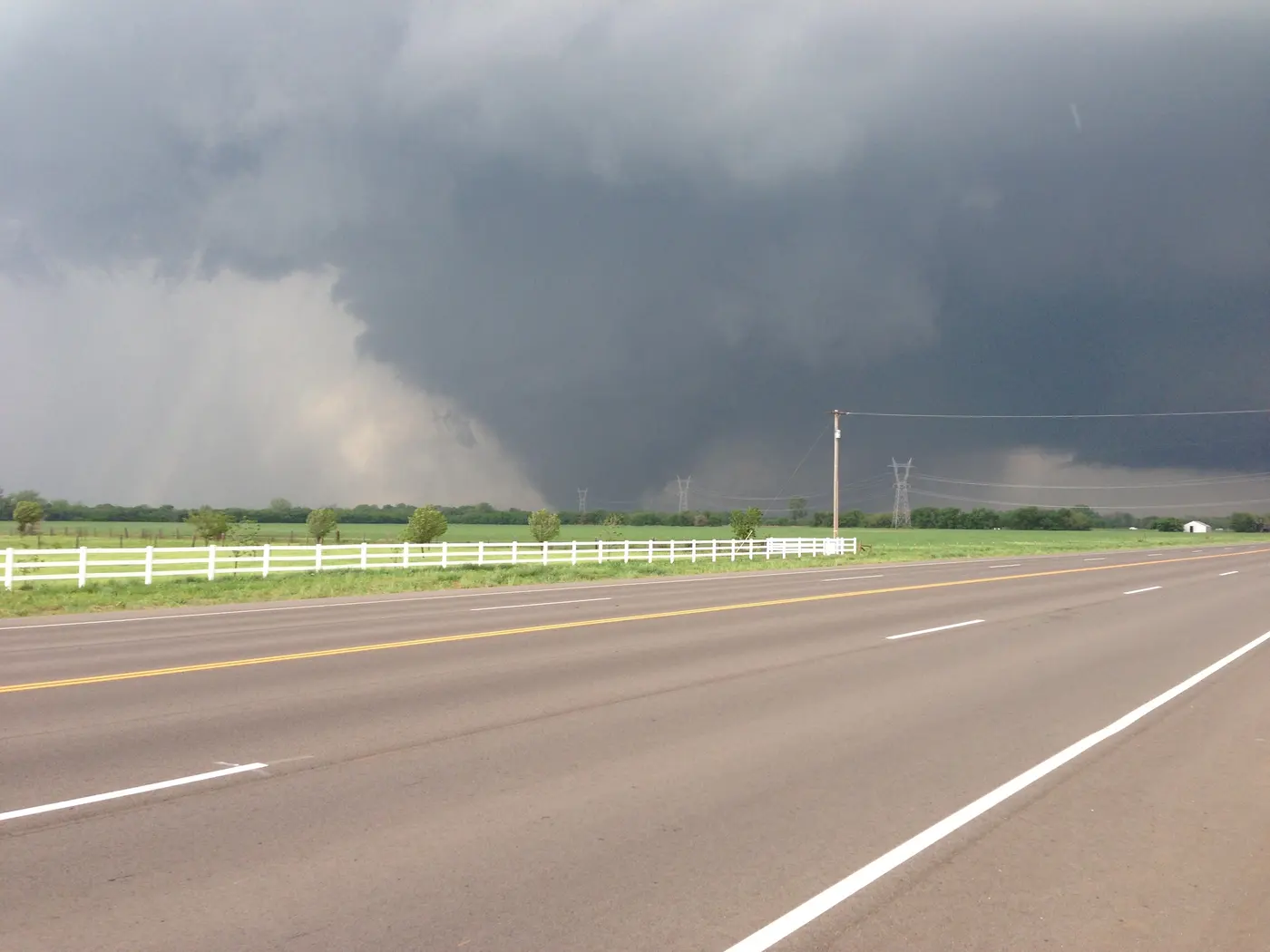
Fourteen miles, thirty-nine minutes, and two elementary schools full of children who had been kept at school because the safest thing to do was keep them there. Twenty-four people died, seven of them in a hallway that the school's own plan named as the place to go. The tornado's EF5 rating rests on nine houses out of more than four thousand damage points, and what happened afterwards was an argument about shelters that Oklahoma is still having.
- Rating
- EF5 200–210 mph estimated
- Deaths
- 24 7 at Plaza Towers
- Injuries
- 212
- Path length
- 14 mi
- Max width
- 1,900 yd 1.1 mi
- On the ground
- 39 min 2:56–3:35 pm CDT
- Warning lead
- 16 min emergency at 3:01 pm
- EF5 indicators
- 9 of 4,222
- Damage
- $2B 2013 USD
- Radar
- KTLX dual-pol available
Thirty-nine minutes
The Storm Prediction Center had a Moderate risk out, not a High one, and Tornado Watch 191 was issued at 1:10 pm. It was not a particularly dangerous situation watch; the phrase does not appear in the product.[3] A severe thunderstorm warning went out at 2:12 pm on a storm near Bridge Creek. The tornado warning followed at 2:40 pm, naming Moore, Norman and Newcastle. The tornado touched down at 2:56 pm in northwest Newcastle, sixteen minutes later.[4]
At 3:01 pm NWS Norman declared a tornado emergency for Moore and south Oklahoma City. Before that afternoon the office had used the phrase exactly twice: for the 1999 F5 and for the 2003 F4, both of which had also struck Moore.[6] Moore's sirens sounded six times.
-
Tornado Watch 191 issued, valid to 10:00 pm.[3]
-
Tornado warning issued, naming Norman, Moore, Newcastle, Bridge Creek and Valley Brook.[4]
-
Touchdown in northwest Newcastle, south of Highway 37.[1]
-
Tornado emergency declared for Moore and south Oklahoma City, only the third the office had ever issued.[4][6]
-
Briarwood Elementary, struck during school hours. Much of the school is destroyed and nobody is killed.[1][6]
-
Plaza Towers Elementary. Seven children die when a hallway wall collapses. Nine more people die in eight homes within a quarter mile.[1]
-
Moore Medical Center, rated EF4, with a car lofted onto the roof of the two-storey building.[1][7]
-
Dissipation in southeast Oklahoma City, 14 miles from where it began.[1]
The radar record
KTLX sits about 20 miles east of Moore, close enough that the lowest tilt samples the storm low, and by 2013 it carried dual-polarisation. That makes this the first tornado on this site where the debris signature is available, and it is unmistakable.
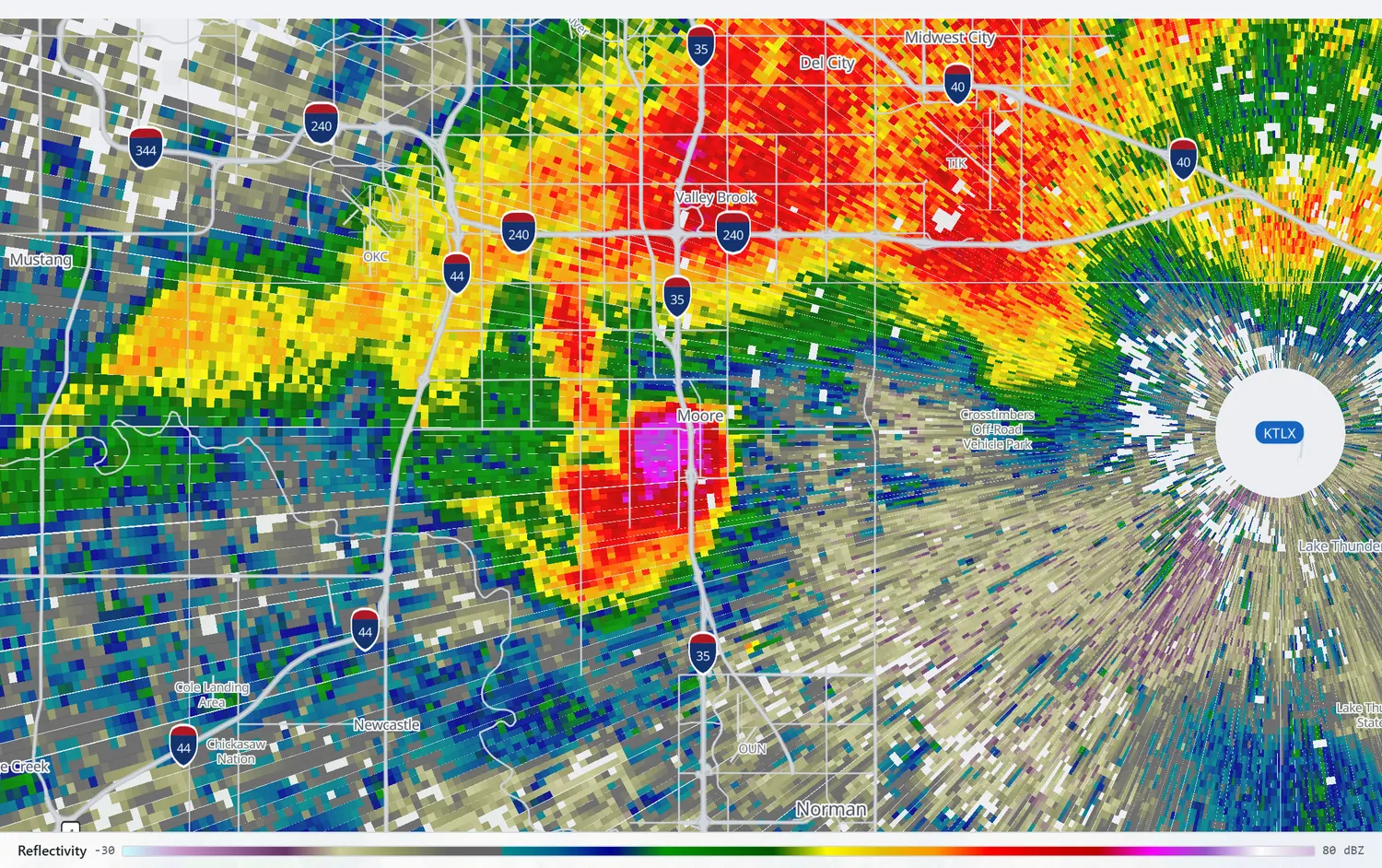
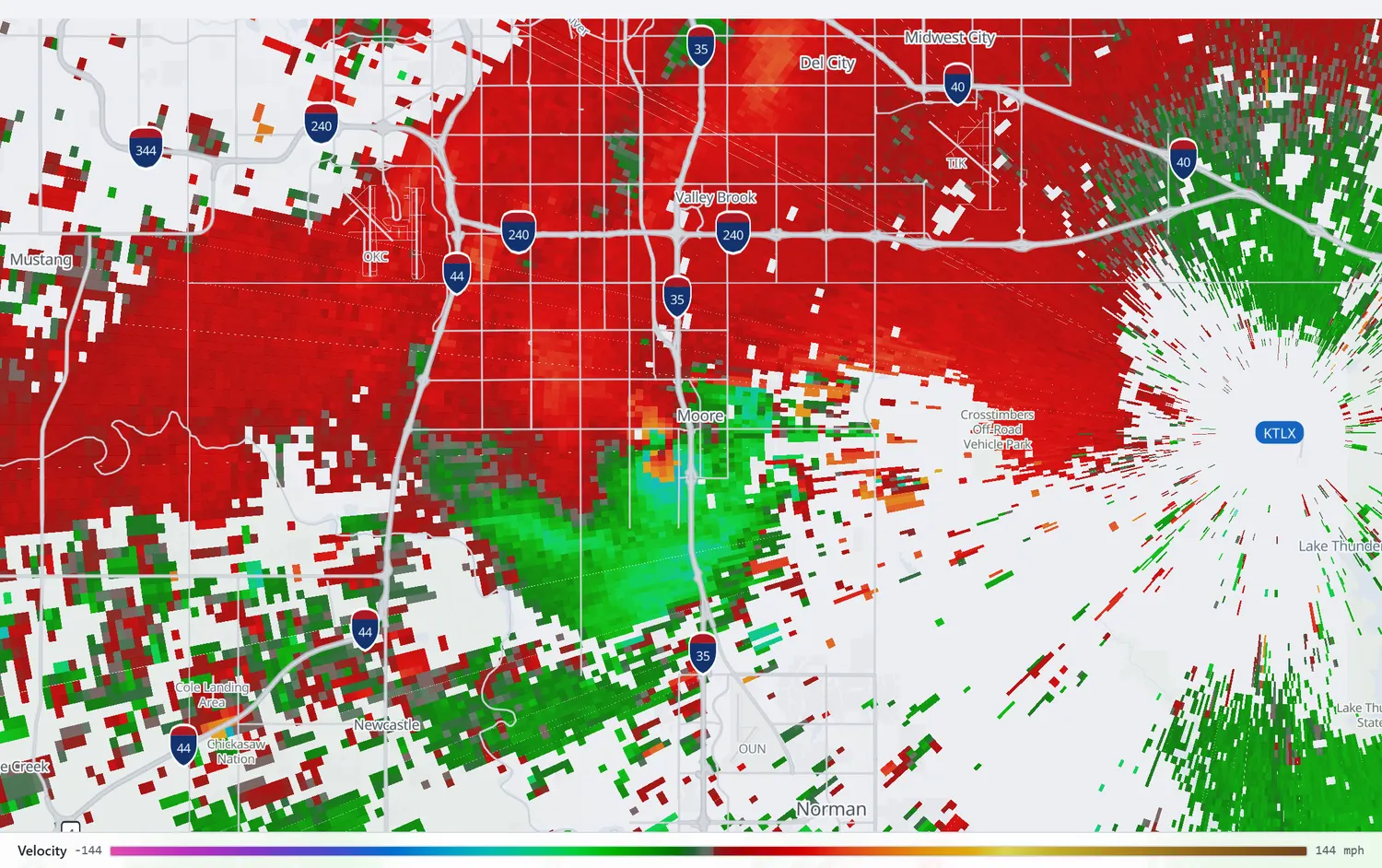
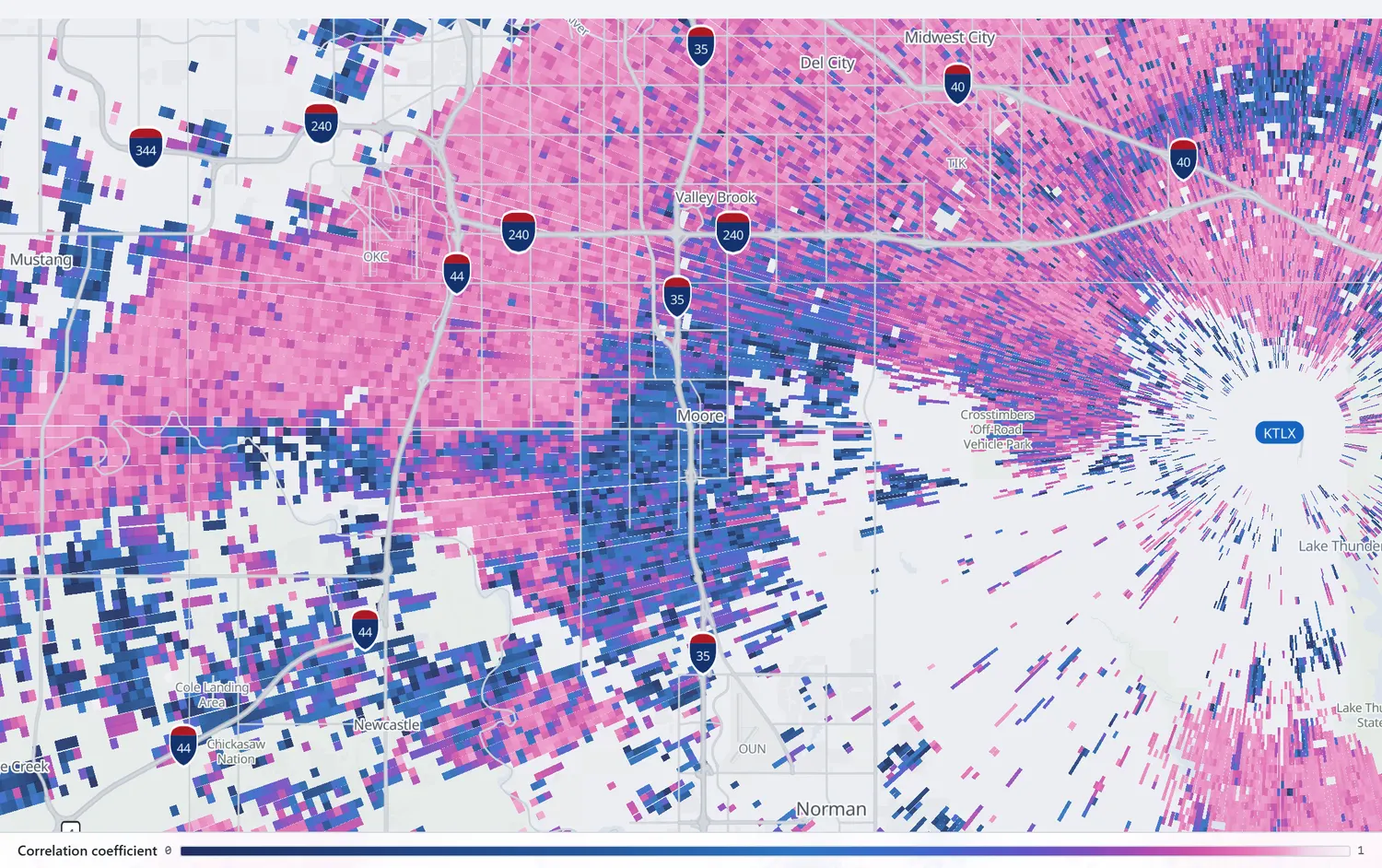
Replay the passage through Moore on KTLX, all three products side by side, opening at 3:20 pm.
Open in the archiveThe schools
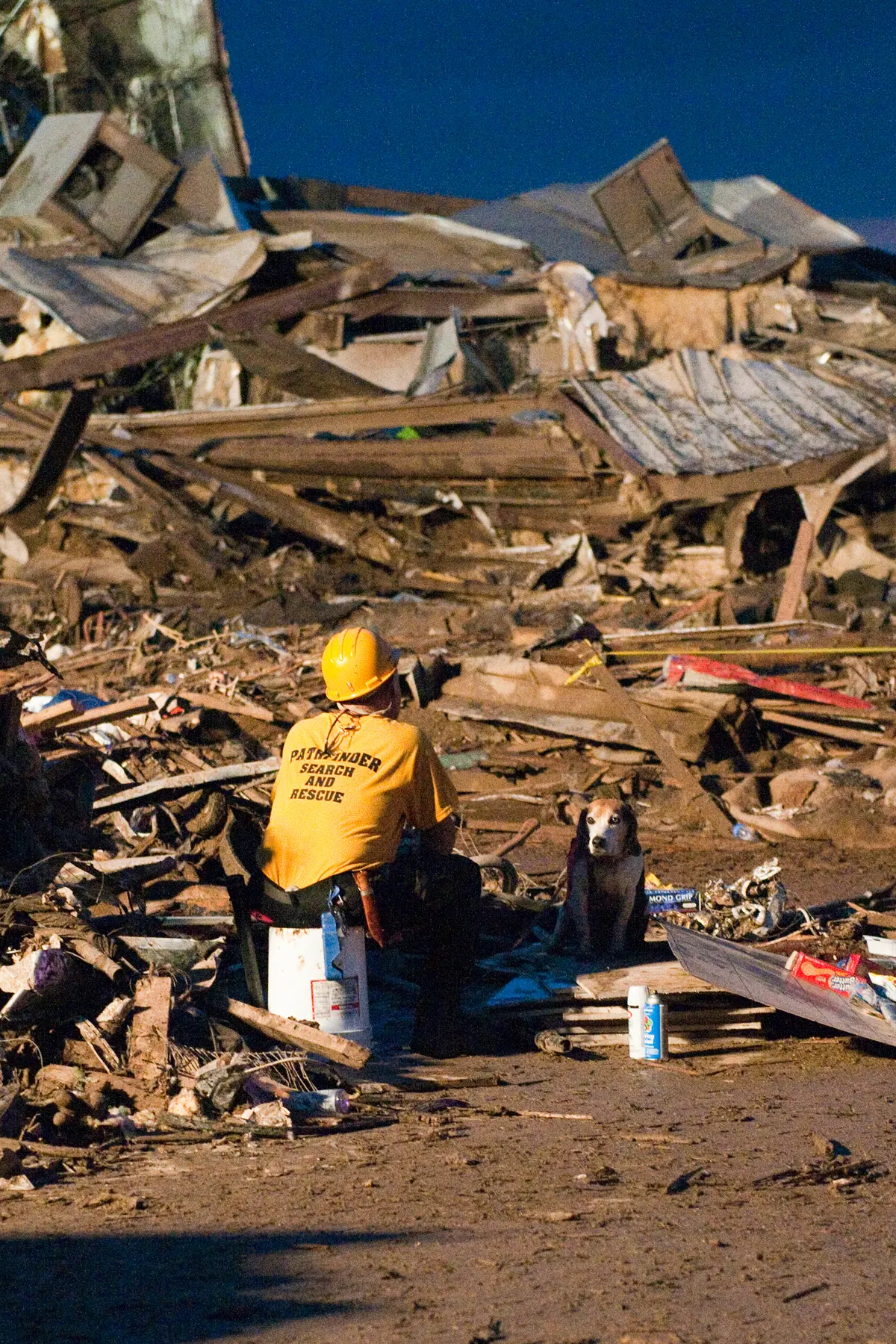

Moore Public Schools cancelled after-school activities by nine that morning and decided by half past one to shelter in place rather than run buses or dismiss at three. That decision was almost certainly right and it is why both schools were full. At Briarwood teachers estimated about two thirds of their students had already been collected early, leaving eight to ten per class instead of the usual twenty-five.[6]
Neither school had a storm shelter, a safe room, or a basement. NIST states that plainly, and also corrects the press reports of the time which said otherwise.[6]
At Plaza Towers, seven children were killed in the interior hallway of the newer classroom building, a formally designated area of safety, when the masonry walls came in. Five died under the west wall; the east wall also collapsed but left a void, and from that space seven or eight students and a teacher were pulled out alive. NIST's conclusion is one sentence and it is unsparing: "the designated safe areas in the new main classroom building at Plaza Towers Elementary School did not provide life safety."[6]
In the school's older building nobody died. A teacher watching the skylights being sucked out moved her class into two bathrooms and a closet, twenty-five to thirty children per bathroom, moments before the roof left. The hallways beside them filled with several feet of debris.[6]
At Briarwood the pattern repeated and nobody was killed. The multipurpose building failed completely, the 300 building was struck by cars and by a ten-ton propane tank thrown half a mile, and in the 200 building and cafeteria "the only spaces that did not collapse were the boys' and girls' bathrooms," enclosed in interior reinforced masonry.[6] The portable classrooms were swept away entirely.
The finding that runs through both schools is the same, and it was a decision made in the last minutes by individual teachers rather than by any plan: smaller interior spaces surrounded by reinforced masonry performed better than the adjacent hallways and classrooms, and staff at both schools moved children into bathrooms that were not in the written procedure.[6]
"They were trying to fit as many kids as they could in the restrooms. And that ended up being the only part that actually stood up."
Malorey Outon, a Briarwood third-grader in 2013[9]
Nine houses
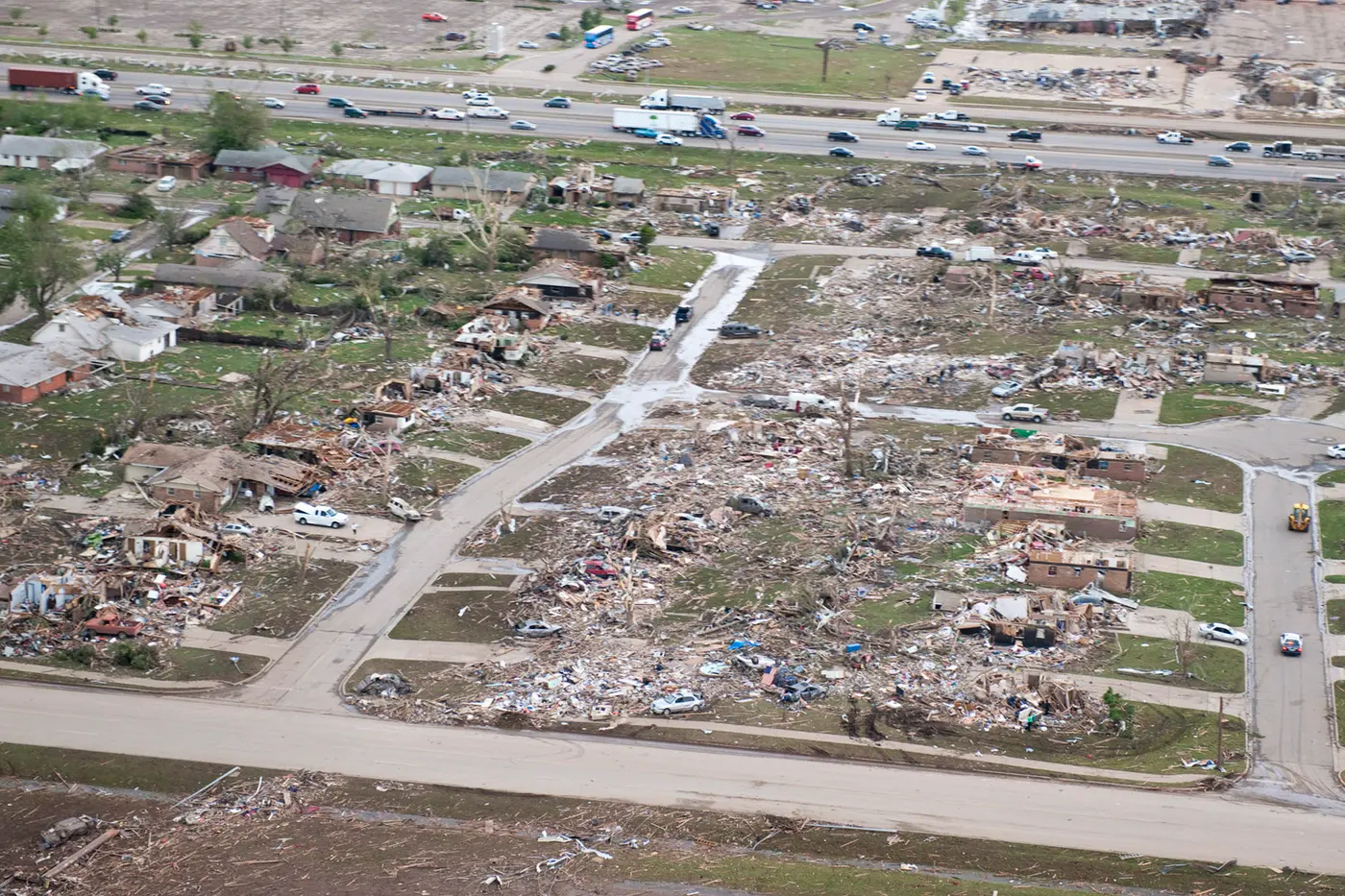
The peer-reviewed damage survey is the clearest account anywhere of what an EF5 rating actually rests on. About twenty-five people surveyed the path over several weeks, using the Damage Assessment Toolkit plus helicopter, satellite and Civil Air Patrol imagery. They evaluated 4,253 damage points, of which 4,222 were formal damage indicators. Half of them were EF0. Of everything rated EF1 or above, 17 percent was EF4 and 0.4 percent was EF5: nine houses.[7]
Because the scale offers no settled definition of a well-built house, the team wrote their own for this survey: the foundation swept clean with debris strewn downwind, slab-to-plate connections with properly spaced bolts and correctly fitted washers and nuts, most base plates removed, and some anchor bolts bent. Their own stated worry sits in the paper: "an EF5 tornado in Oklahoma might not be an EF5 tornado in some other place with different building codes and different building practices."[7]
The schools did not carry the rating, and one of them lost it. NWS Norman rated the Briarwood damage EF5 and NIST records that as the basis of the 200 to 210 mph peak wind estimate. The survey paper reports that a later engineering investigation by the American Society of Civil Engineers found construction flaws requiring a reduction to EF4, and that a separate multi-university team independently assessed EF4. As of the paper's publication the official school rating had not been changed.[6][7] Plaza Towers was rated EF4 throughout, on construction practice, as were homes swept clean of their foundations just south of it.
One detail links this tornado to the one that crossed nearly the same ground fourteen years earlier. A Westmoor house initially rated EF5 was reduced to EF4 because the nuts and washers were missing from its anchor bolts. The survey team notes that most homes near Plaza Towers had been built after the 1999 F5, and still did not have adequate base plate connections to their foundations.[7]
The count that fell
For about eighteen hours the reported death toll was far higher than the real one. Initial figures were at least 51 with fears of ninety. On the Tuesday morning the Oklahoma City medical examiner's office announced the confirmed count was 24. The reason was double counting: with cell phones down, officials in the field were relaying fatalities over two-way radios and some victims were reported more than once.[10]
Injuries went the other way and then back: reported first around 240, then over 350, and settled at 212 in the official record. NIST separately cites the Oklahoma Department of Emergency Management for 387 people treated at hospitals, which is a different counting basis rather than a contradiction.[6][2] The Emergency Management department reports 25 deaths including a woman who died in August; the National Weather Service record says 24. Both are official.
The service assessment's fatality appendix records where the 24 died: seven children at Plaza Towers, three people sheltering in a convenience store on Telephone Road, thirteen sheltering in homes, most of them in a closet or a bathtub, and one in a business. Unlike El Reno eleven days later, there were no vehicle deaths at all.[5]
The shelter argument
Before the tornado, two of Moore's thirty-two school buildings had shelters, and about a quarter of Oklahoma schools statewide.[11] There were no public or community shelters in Moore at all. The city's policy was to shelter in place, on the reasoning that no public building had a suitable space and that travelling to a shelter in the available warning time was itself the greater risk. Over 3,000 residential shelters were registered with the city, which NIST suggests may be the highest per capita in the country, and every one of them was voluntary.[6]
NIST is blunt about the codes in force. Moore was enforcing the 2009 international building and residential codes, and "tornadoes are not explicitly considered in either for any types of buildings, except storm shelters."[6]
The campaign that followed, Take Shelter Oklahoma, proposed a $500 million bond issue to put shelters in every public school, serviced from the state franchise tax. Governor Mary Fallin declined to back it: "I am not sure that is the best way of doing it." The petition drive failed to gather enough signatures, twice, and a legislative route failed in 2014. No statewide mandate was ever enacted, and Oklahoma still has no building code requiring school shelters.[12][11]
Moore did it locally. A bond passed in 2015 and by 2019 the city confirmed that every school site in the district had an engineered safe room, a move from two buildings out of thirty-two to all of them.[11][13] Statewide the picture stayed patchy: 57 percent of schools had shelters by the tenth anniversary, against 25 percent in 2013, and a 2026 regional survey found roughly 28 percent of students had access to a rated shelter during the school day. Those two figures count different things, buildings against pupils, and should not be read as a decline.[11]
Moore also rewrote its residential building code, becoming in 2014 the first American city to adopt tornado-specific construction standards for houses: a 135 mph design wind speed where typical codes then required 90, plus roof sheathing rules, hurricane clips, continuous bracing and wind-rated garage doors. The engineers expected it to cost about a dollar a square foot and it came in at two or more. An economist studying the market afterwards found "little to no effect" on how many homes were built and sold.[14] It is worth being exact about what that code buys: 135 mph is roughly EF2. It is not designed to survive what happened on May 20.
Moore, again
NWS Norman's own tornado database for the city lists 23 tornadoes affecting Moore between 1893 and 2015, including an F5 in 1999, an F4 in 2003, an EF4 in 2010 and this EF5. NIST notes that Moore is one of only a few communities anywhere to have been struck by two F5-or-EF5 tornadoes.[15][6]
The temptation is to reach for an explanation, and the honest answer is that the official one is unglamorous. NWS Norman attributes the Oklahoma City area's reputation to "its large areal extent and location near the heart of tornado alley," and counts 194 tornadoes across roughly 600 square miles of metro since 1890.[15] The peer-reviewed survey's sharpest finding about recurrence is not meteorological at all: it is that homes rebuilt after 1999 failed the same way in 2013.[7]
One more thing NIST checked, because the obvious hypothesis was complacency. Moore had been a StormReady community since 2001. Between October 2007 and May 19, 2013, sixteen tornado warnings covered part or all of the city and twelve verified: a 25 percent false alarm rate against a national average around 74.[6] Whatever went wrong in Moore, it was not that the warnings had been crying wolf.
Related
Bridge Creek-Moore, 1999, which crossed nearly the same ground · El Reno, eleven days later and twenty miles west, whose victims all died in cars fleeing after this · Joplin, whose NIST recommendations this investigation cites · All tornado profiles
Sources
Times are CDT (UTC−5). Where the official death and injury counts differ between agencies, both are given rather than reconciled.
- NWS Norman, The May 20, 2013 Newcastle-Moore EF5 Tornado.
- NCEI Storm Events Database, events 451537 and 451572 (McClain and Cleveland counties, May 20, 2013), via the bulk detail files. The tornado is held as two county segments totalling 13.85 miles, 212 injuries and 24 deaths.
- Storm Prediction Center, Tornado Watch 191, May 20, 2013. Contains no particularly dangerous situation wording.
- NWS Norman, products issued for the May 20, 2013 event, including the 2:40 pm tornado warning and the 3:01 pm tornado emergency.
- NOAA/National Weather Service, Service Assessment: May 2013 Oklahoma Tornadoes and Flash Flooding, March 2014. Source of the fatality appendix and the warning performance figures.
- Kuligowski, E. D., L. Phan, M. Levitan and D. Jorgensen: Preliminary Reconnaissance of the May 20, 2013, Newcastle-Moore Tornado in Oklahoma. NIST Special Publication 1164. Source of the school building performance findings.
- Burgess, D., and others, 2014: 20 May 2013 Moore, Oklahoma, Tornado: Damage Survey and Analysis. Weather and Forecasting, 29, 1229–1237. doi:10.1175/WAF-D-14-00039.1
- Texas Tech National Wind Institute, May 20, 2013 Moore tornado shelter performance report. Documented 61 shelters of three types, with no loss of life in any of them.
- OKC Fox, Briarwood and Plaza Towers, ten years on.
- KPBS, Death toll from devastating tornado revised down, May 21, 2013.
- News On 6, Moore's 2013 tornado sparks change, and KGOU, Oklahoma schools make storm shelters a priority, May 2018.
- StateImpact Oklahoma, Why Gov. Mary Fallin won't back the school storm shelter ballot measure, September 30, 2013.
- City of Moore, storm shelters.
- Oklahoma Gazette, Moore's code, and KGOU, Five years after the tornado, Moore's stronger building codes haven't hurt the market.
- NWS Norman, tornadoes affecting Moore, 1893–2015 and the Oklahoma City area tornado database.
Radar imagery on this page was rendered by WeatherOverTime from NOAA Level II data recorded by KTLX. Corrections: contact@weatherovertime.com.